Section 1: Requirement RA1 – gigabit-ready physical infrastructure Application
Application
1.2
Requirement RA1 for gigabit-ready physical infrastructure applies to the erection of a new dwelling or of a building that contains one or more dwellings.
1.3
A new dwelling may be a dwelling-house or a flat in a building that contains one or more dwellings.
1.4
New dwellings include the following:
1.5
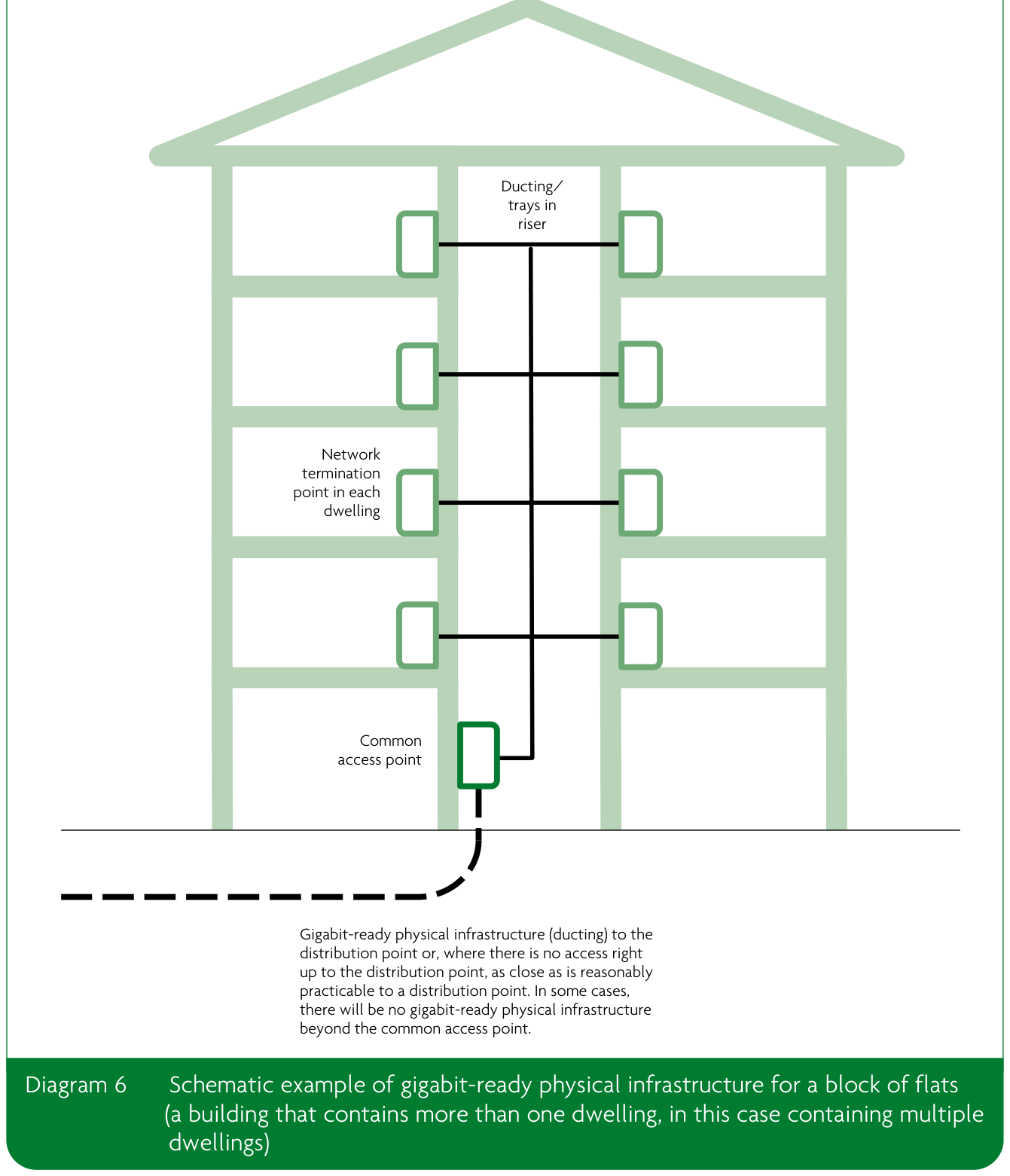
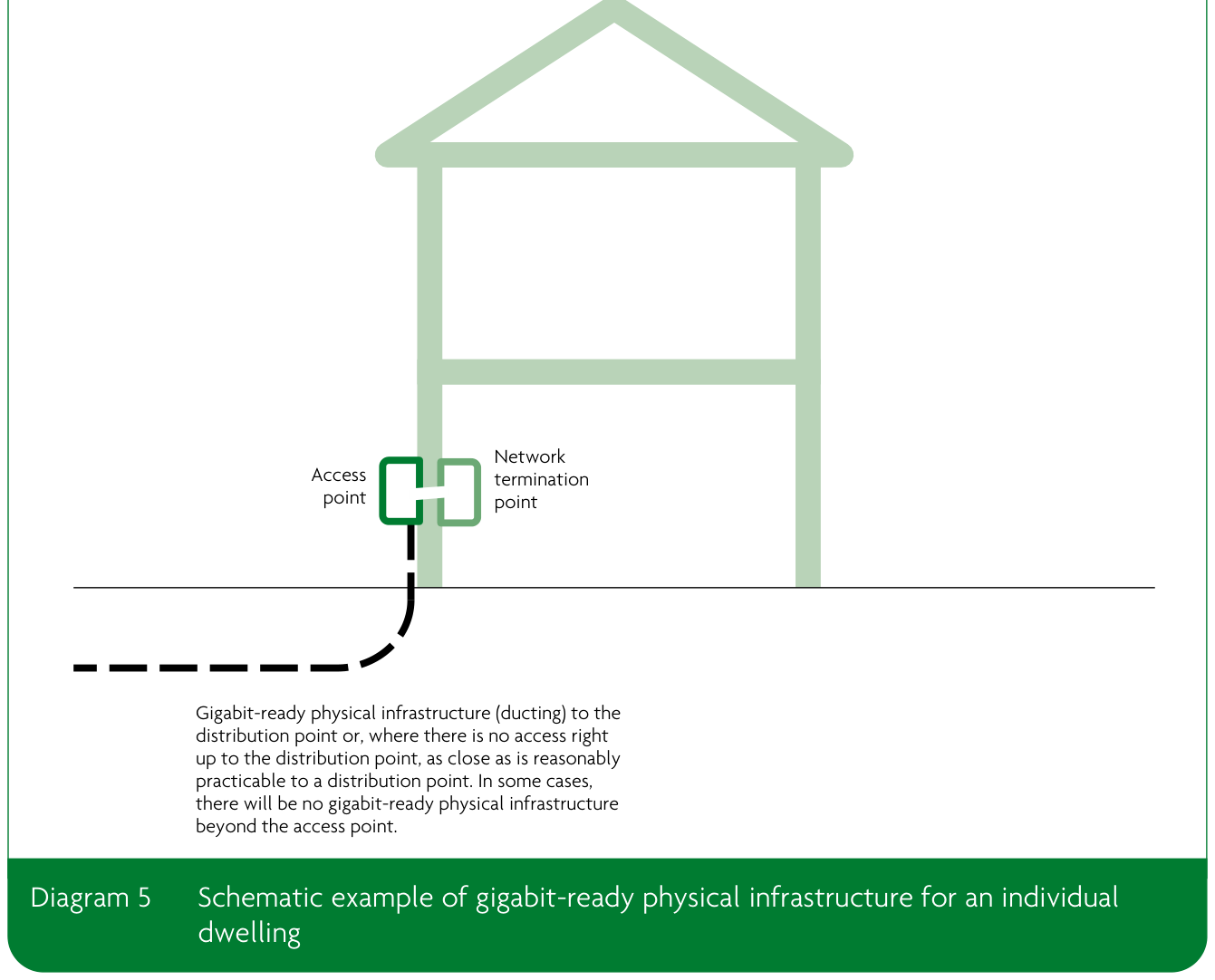
Where a new building contains more than one dwelling, a common access point for a gigabit-capable public electronic communications network is required as a part of the building’s gigabit-ready physical infrastructure. In-building physical infrastructure is required from the common access point to the network termination points in each dwelling (see Diagram 6). In single-dwelling buildings, an access point is required as part of the gigabit-ready physical infrastructure (see Diagram 5).
1.6
Requirement RA1 does not apply to the following types of dwellings, buildings or building work.
1.7
Where a developer seeks to rely on the building being in an ‘isolated area’ as a reason to exempt new dwellings from requirement RA1, the developer must provide evidence in support of the exemption. This should include an explanation of how new dwellings are in an area that is isolated from a relevant connection, that the cost of providing a USO-standard public electronic communications network connection exceeds the cost cap and why the prospect of a connection to a relevant network in the isolated area is considered too remote to justify equipping the building with the relevant gigabit-ready physical infrastructure. The application of this exemption will vary in different circumstances.
NOTE: This evidence can be provided with the information submitted with the application for Building Regulations approval. The connectivity plan at Appendix B, which sets out a template for developers, can be used to provide such evidence and information.
1.8
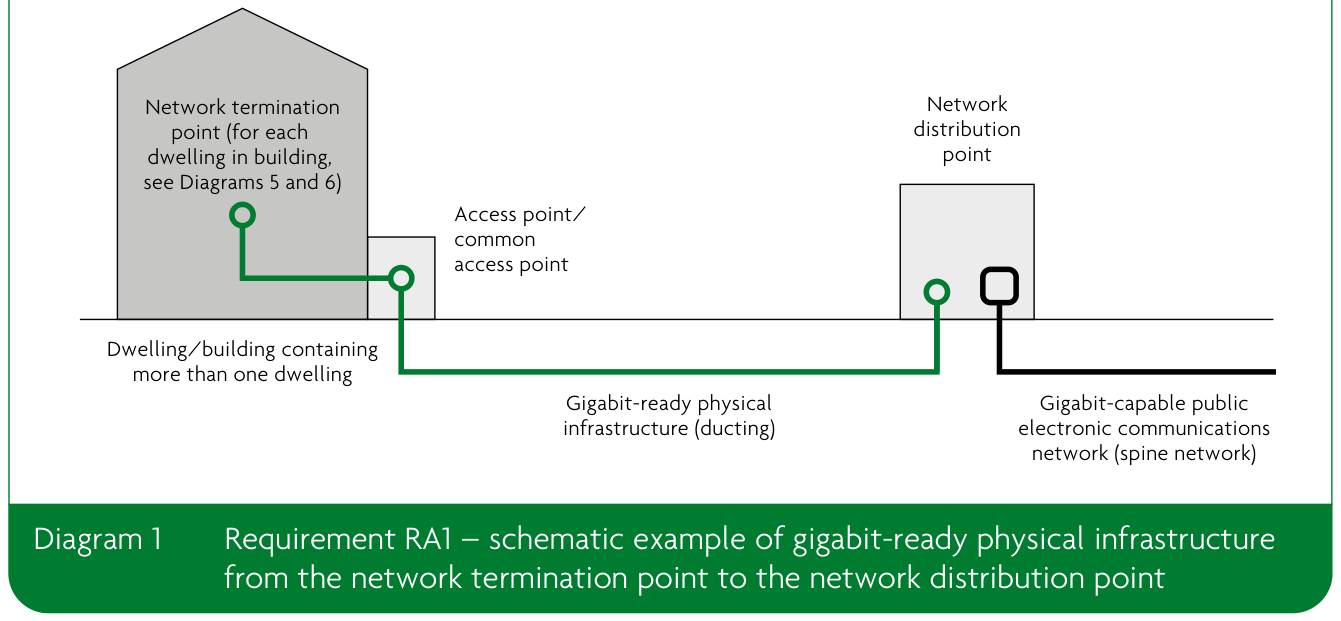
Requirement RA1 requires that the developer installs gigabit-ready physical infrastructure from the network termination point to the network distribution point, where the developer has access rights over the relevant land (see Diagram 1).
NOTE: All the diagrams in this approved document (Diagrams 1 to 6) are simplified. Developers should refer to specific guidance and the requirements of the Building Regulations when planning gigabit-ready physical infrastructure with network operators.
NOTE: All the diagrams in this approved document (Diagrams 1 to 6) reflect full fibre gigabit-ready physical infrastructure. Where fixed wireless access or satellite technology is deployed, such infrastructure will be installed differently. Diagrams 5 and 6 provide more detail on gigabit-ready physical infrastructure inside the dwelling.
Diagram 1 Requirement RA1 – schematic example of gigabit-ready physical infrastructure from the network termination point to the network distribution point
1.9
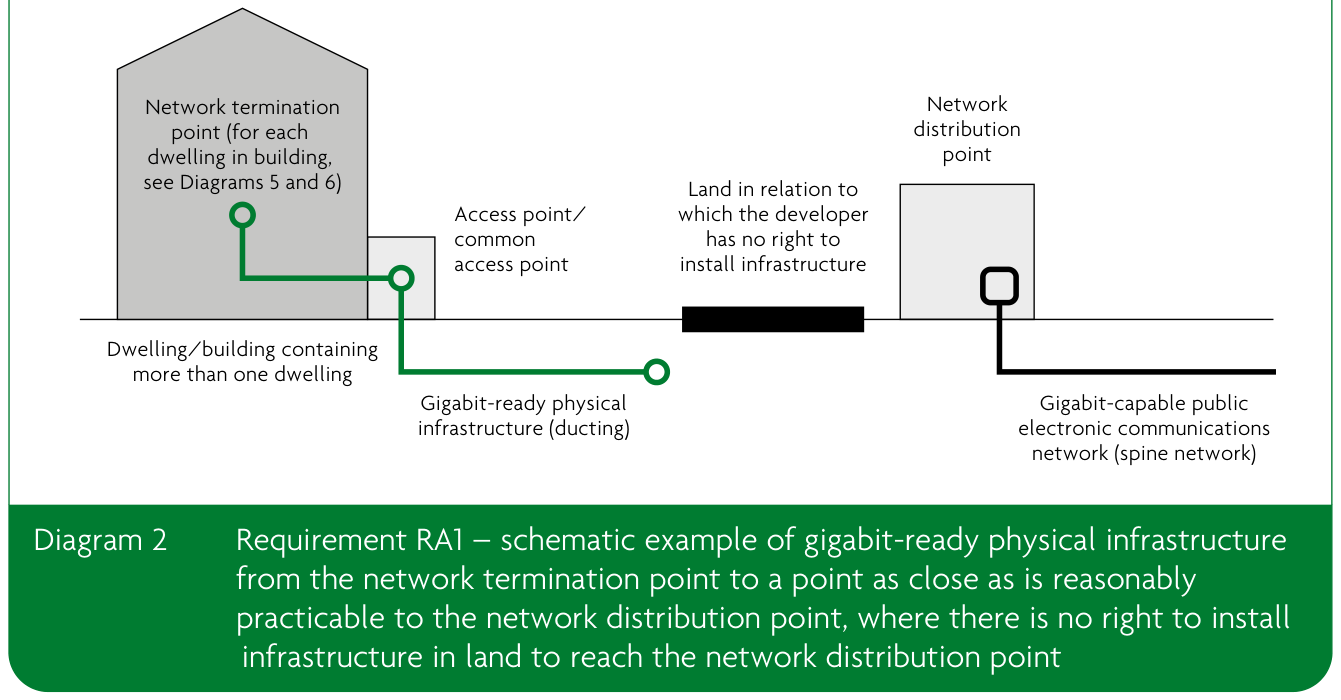
Where the developer does not have the right to extend the infrastructure to the distribution point, the developer is required to extend the infrastructure to the point that is as close as is reasonably practicable to the network distribution point (see Diagram 2).
1.10
For example, if there is a point that is as close to the distribution point as the developer can extend the gigabit-ready physical infrastructure to, but this would not be reasonably practicable for the developer due to the condition of the land in question, the infrastructure should be extended to an alternative point that is reasonably practicable. Developers are encouraged to work with relevant network operators to identify suitable routes for such infrastructure.
Diagram 2 Requirement RA1 – schematic example of gigabit-ready physical infrastructure from the network termination point to a point as close as is reasonably practicable to the network distribution point, where there is no right to install infrastructure in land to reach the network distribution point
1.11
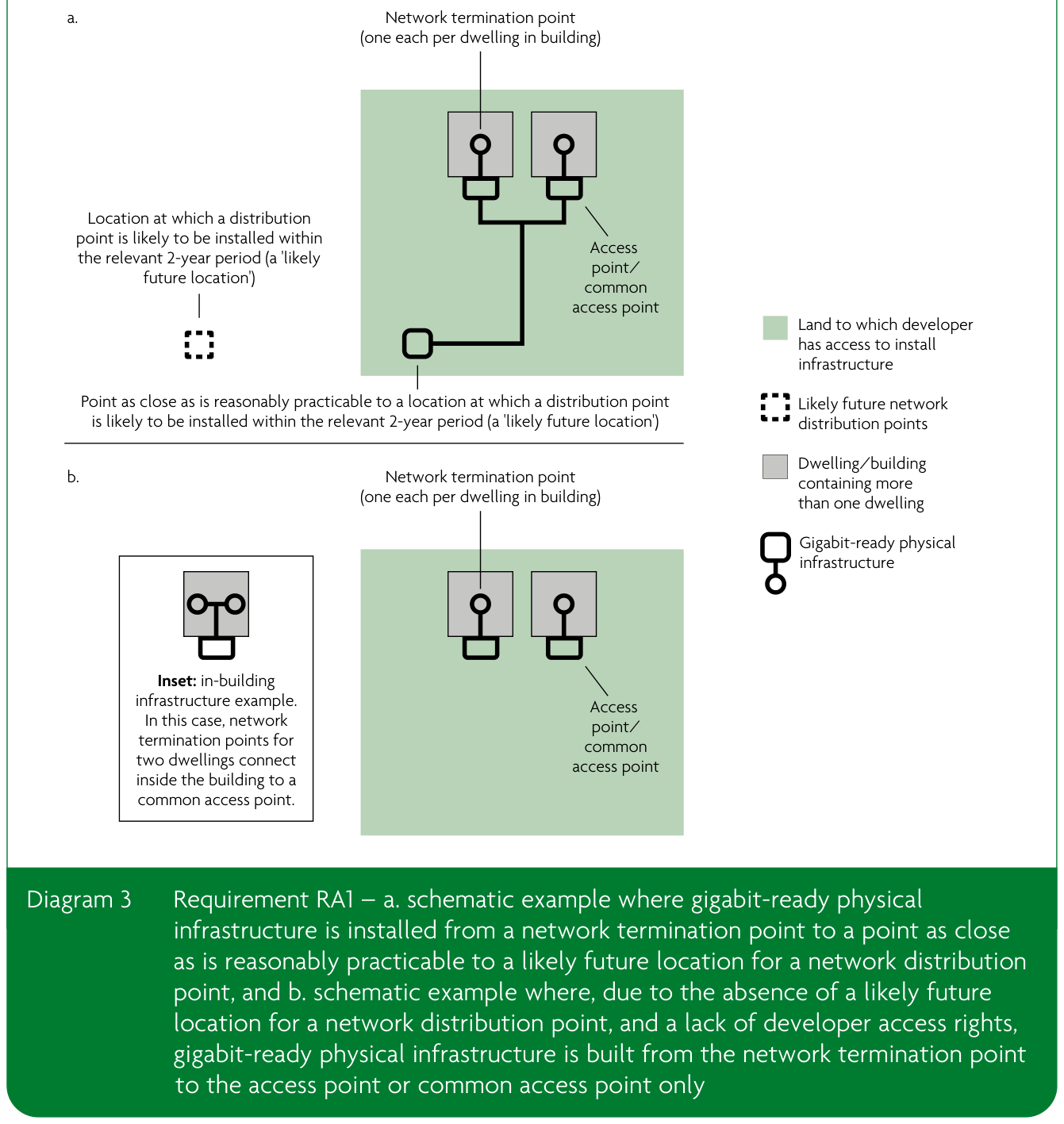
Where the developer has no right over the land in question and where no connection to a gigabit-capable public electronic communications network is being provided because requirement RA2 is excluded or modified, and would be even if the gigabit-ready physical infrastructure was required to reach as close as is reasonably practicable to the distribution point, the developer is required to install the infrastructure to a point as close as is reasonably practicable to a location at which it reasonably expects a distribution point to be installed within the relevant 2-year period, i.e. a likely future location (see Diagram 3a).
1.12
A developer will need to liaise with a network operator to ascertain the likely future location of a suitable network distribution point and provide evidence of having done so. Where a ducting system is being used, this is likely to be situated by the public highway.
1.13
The developer will need to provide evidence to a building control body of the steps undertaken to establish if an appropriate network distribution point is to be installed within the relevant 2-year period and where it is to be located. Developers will also need to provide evidence of the steps undertaken should it be the case that there is no likely future location of an appropriate network distribution point within the relevant 2-year period. Developers should ascertain this information from a network operator when inviting them to provide a relevant connection.
1.14
Where there is no likely future location of a network distribution point that is closer to the dwelling than an existing distribution point and the developer cannot access land to a distant network distribution point, the developer is required to install infrastructure to an access point (see Diagram 3b).
1.15
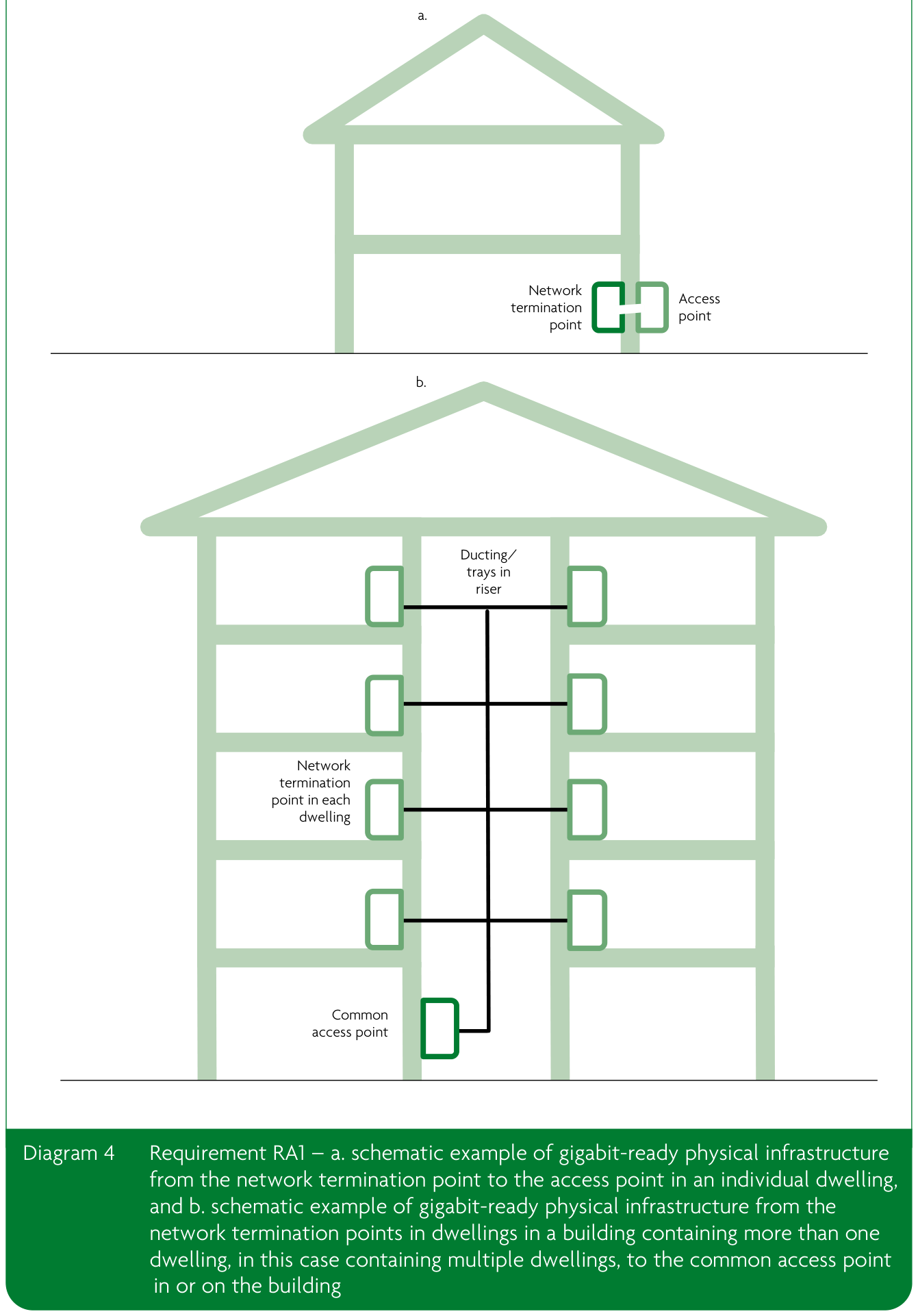
Where there is no right to install gigabit-ready physical infrastructure in land beyond the building, the developer is required to install gigabit-ready physical infrastructure to an access point for an individual dwelling and to a common access point for buildings containing multiple dwellings (see Diagrams 4a and 4b).
Diagram 3 Requirement RA1 – a. schematic example where gigabit-ready physical infrastructure is installed from a network termination point to a point as close as is reasonably practicable to a likely future location for a network distribution point, and b. schematic example where, due to the absence of a likely future location for a network distribution point, and a lack of developer access rights, gigabit-ready physical infrastructure is built from the network termination point to the access point or common access point only
1.16
A building control body will assess the particulars submitted by the developer in relation to the connection which is to be provided and any evidence provided in support of a reliance on any exemptions when considering whether building work has been completed within the requirements. The connectivity plan at Appendix B, which sets out a template for developers, can be used to provide such evidence and information.
NOTE: Street Works UK provides the following guidelines regarding groundworks infrastructure: Street Works UK Guidelines on the Positioning and Colour Coding of Underground Utilities’ Apparatus, Volume 1, Issue 9 [2018].
1.17
The requirement to provide equipment such as an optical fibre cable or other technological means of facilitating a connection to a gigabit-capable public electronic communications network (requirement RA2) is separate to requirement RA1. Requirement RA1 relates to the installation of the infrastructure needed to host this equipment.
1.18
To install gigabit-ready physical infrastructure to a network distribution point, developers will need to work closely with network operators. Where there is a choice of network distribution points, developers should work with network operators to choose which network distribution point would be appropriate and ascertain the corresponding location of the infrastructure.
NOTE: Early engagement with network operators will help to ensure developers are aware of factors that may need mitigation – such as obstacles and terrain – that network operators may be able to assist with. Developers should work with network operators from the earliest possible date.
1.19
Where a ducting system is being used for installation of gigabit-ready physical infrastructure to a network distribution point, installation is likely to be to a point where the development site meets the public highway.
NOTE: Where a next fastest broadband connection or no connection to a public electronic communications network can be provided within the cost cap (see paragraphs 2.13 to 2.23), new dwellings must still be erected with gigabit-ready physical infrastructure installed to be ready to support a connection to a gigabit-capable public electronic communications network in the future. In these cases, the gigabit-ready physical infrastructure is required to have sufficient capacity and dimensions to install and host a gigabit-capable public electronic communications network connection for each dwelling.
Diagram 4 Requirement RA1 – a. schematic example of gigabit-ready physical infrastructure from the network termination point to the access point in an individual dwelling, and b. schematic example of gigabit-ready physical infrastructure from the network termination points in dwellings in a building containing more than one dwelling, in this case containing multiple dwellings, to the common access point in or on the building
1.20
Once the infrastructure has been planned, developers should provide the required particulars to a building control body demonstrating how the proposed approach complies with requirement RA1 and whether any exemptions are to be relied upon. Particulars provided by way of the connectivity plan would further assist the building control body if they contain evidence to demonstrate the location of gigabit-ready physical infrastructure. This could take the form of schematic diagrams, maps setting out the site layout and written evidence.
1.21
One way to meet the requirement for gigabit-ready physical infrastructure which extends beyond the dwelling is to design and install a system of ducts, chambers, cabinets, towers and poles that can facilitate at least one gigabit-capable public electronic communications network connection for all the dwellings serviced by that infrastructure.
1.22
In most cases, this requirement is likely to be met by infrastructure for full fibre connections (optical fibre cable from the dwelling to the network distribution point). However, as the requirement is technologically neutral, any form of wired or wireless technologies that meet the performance requirements may be used.
1.23
Where full fibre connections are not available, other means of providing gigabit-capable public electronic communications network connections – such as Data Over Cable Service Interface Specification (DOCSIS 3.1) or a fixed wireless access technology – should be explored before pursuing a next fastest broadband connection.
NOTE: The requirement does not preclude the voluntary installation of gigabit-ready physical infrastructure capable of supporting connections provided by multiple network operators or the installation of multiple forms of gigabit-ready physical infrastructure supporting multiple connections.
NOTE: Further information about gigabit-ready physical infrastructure and gigabit-capable public electronic communications network connections is to be made available on the UK Government Digital Connectivity Portal at https://www.gov.uk/guidance/digital-connectivity-portal.
1.24
Where an access point is installed at a dwelling to facilitate connection to a gigabit-capable public electronic communications network, the ingress of moisture into the building and air leakage from the building should be prevented.
1.25
Diagram 5 shows an example of gigabit-ready physical infrastructure for a single dwelling. The access point is on an outside wall and is connected by a ‘through wall’ duct to the network termination point.
1.26
For a building that contains more than one dwelling, such as a block of flats, a common access point and gigabit-ready physical infrastructure inside the building are required. Developers can also design and install a system of risers, floor boxes, cable trays and ducts from the common access point to each dwelling in the building. See Diagram 6 for an example.
Diagram 5 Schematic example of gigabit-ready physical infrastructure for an individual dwelling
1.27
For a building that contains more than one dwelling, the gigabit-ready physical infrastructure inside the building should have sufficient capacity and dimensions to host at least one gigabit-capable public electronic communications network connection for each dwelling.
1.28
The gigabit-ready physical infrastructure inside a building should comply with all relevant requirements of the Building Regulations. These include the requirements of Part B of Schedule 1 to the Building Regulations (Fire safety), including the need for fire stopping at penetrations through compartment walls, floors and ceilings, and the ban on combustible materials in the external walls of relevant buildings (regulation 7 of the Building Regulations).
1.29
Where a gigabit-capable connection is not installed pursuant to requirement RA2, the gigabit-ready physical infrastructure should be installed in such a way that it is protected from any deterioration resulting from exposure to the elements, so that it is ready to host connection to a gigabit-capable public electronic communications network in the future. For example, ducting under land should be fully covered, and any infrastructure protruding from the building or ground should be encased where possible.
NOTE: Consideration should be given to the positioning of network termination points installed within the dwelling to ensure good connectivity throughout the dwelling, such as in central, open areas of the dwelling. See NHBC Foundation’s NF67 The Connected Home: Designing and Building Technology into Today’s New Homes [2016].
Diagram 6 Schematic example of gigabit-ready physical infrastructure for a block of flats (a building that contains more than one dwelling, in this case containing multiple dwellings)